

A world map based on UN data reveals two types of countries: those with more births than deaths (natural population growth) and those with more deaths than births (natural population decline). This demographic divide, highlighted by Our World in Data, shows the future challenges for economies and public systems worldwide.
The map represents natural population change during 2023, calculated as the difference between births and deaths. It excludes migration, focusing solely on reproductive dynamics. The data comes from the UN's World Population Prospects 2024 report, which used 1,910 censuses, birth and death records from 169 countries, and 3,189 demographic surveys—a comprehensive dataset.
Find Original Home Decor sparking conversation at Grand Goldman Shop.

What the Map Shows: Blue vs. Orange
Countries in blue have more births than deaths, leading to natural population growth. Countries in orange have more deaths than births, resulting in natural population decline. This simple color coding reveals a stark contrast: while some nations continue to grow, others face the prospect of shrinking populations unless migration compensates.
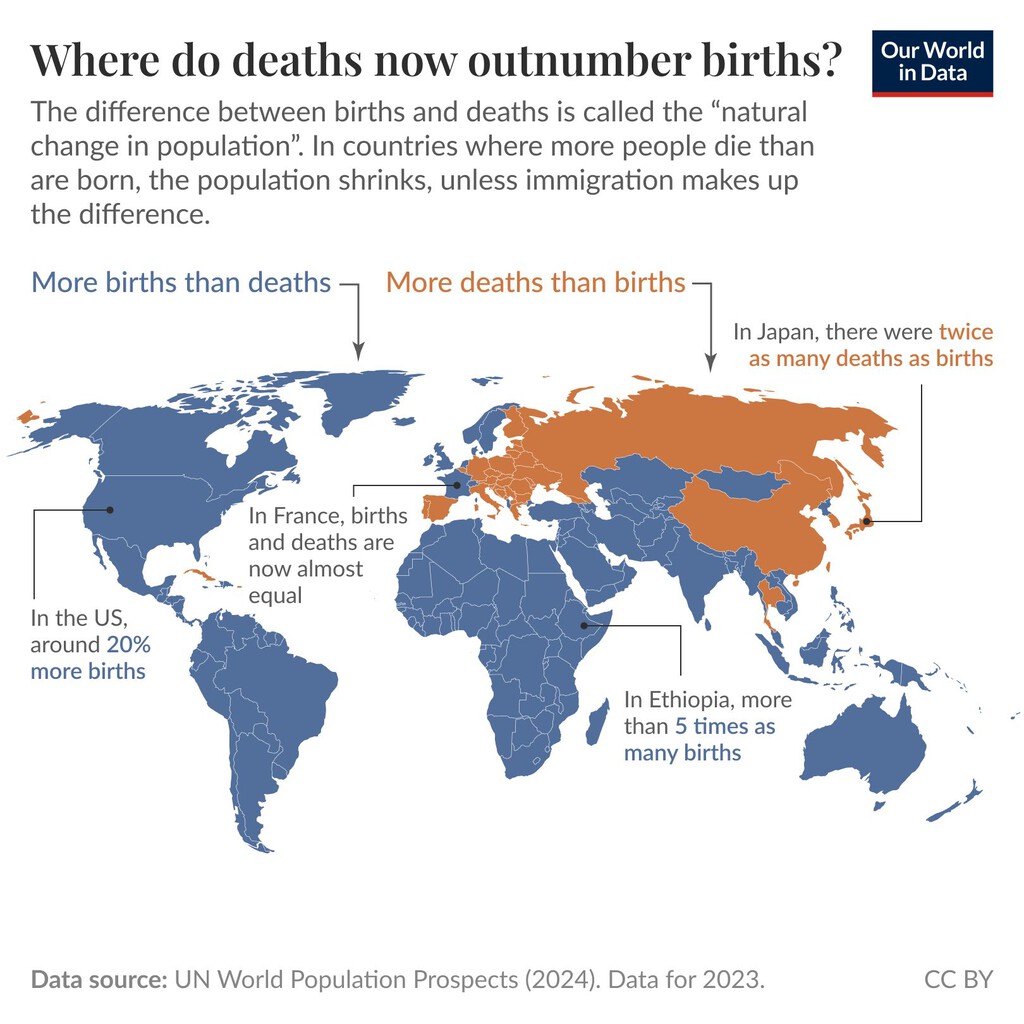
The map's power lies in its simplicity. It doesn't account for migration, so it purely reflects each society's reproductive dynamics. This is crucial because natural change is the foundation of long-term demographic trends. Without migration, a country with more deaths than births will eventually see its population decline.
Why Natural Population Change Matters
Natural population change is a key indicator of a country's demographic health. It affects the size of the labor force, the dependency ratio, and the sustainability of social systems like healthcare and pensions. A growing population can drive economic expansion, while a shrinking one can strain public finances.
Moreover, natural change is slow-moving but powerful. It doesn't happen overnight, but its effects accumulate over decades. Countries with sustained natural decline may face labor shortages, reduced consumer demand, and increased pressure on social services. Conversely, countries with rapid growth may struggle to provide enough jobs, housing, and infrastructure.
Key Takeaways from the Demographic Divide
- Two distinct groups: Countries are split between those with natural growth (blue) and natural decline (orange).
- Migration excluded: The map isolates reproductive dynamics, showing the underlying trend without the offset of migration.
- UN data: Based on the World Population Prospects 2024, using extensive census and survey data.
- Long-term implications: Natural decline can lead to population shrinkage and economic challenges if not offset by migration or policy changes.
- Global shift: Many developed countries are in the orange category, while many developing countries are blue.
Country Examples: A Contrasting Picture
While the map doesn't label individual countries, the pattern is clear: many European nations, Japan, and South Korea fall into the orange category, with deaths exceeding births. In contrast, many countries in Sub-Saharan Africa, parts of South Asia, and some Middle Eastern nations are blue, with high birth rates driving growth.
This divide has significant geopolitical implications. Countries with shrinking native populations may need to rely on immigration to sustain their workforce and economic growth. Those with growing populations may become more influential demographically, but they also face the challenge of providing opportunities for their youth.
Comparison of Demographic Trends by Region
| Region | Natural Population Change (2023) | Primary Trend |
|---|---|---|
| Europe | More deaths than births | Natural decline |
| Sub-Saharan Africa | More births than deaths | Natural growth |
| East Asia | More deaths than births (e.g., Japan, South Korea) | Natural decline |
| South Asia | More births than deaths (e.g., India, Pakistan) | Natural growth |
| North America | Mixed (US growth, Canada decline) | Varies |
What This Means for Economies and Societies
The demographic divide is not just a statistical curiosity; it has real-world consequences. Countries with natural decline may face labor shortages, which can slow economic growth and increase the burden on social welfare systems. They may also experience a shrinking tax base, making it harder to fund public services. The longer history behind the story is traced in World Map Reveals Two Types of Countries: Demographic Growth vs Decline. More on the surrounding debate is collected in Doomsday Prediction 2026: Why the World Didn't End Today.
On the other hand, countries with natural growth have a demographic dividend—a young and growing workforce that can drive economic expansion. However, this dividend is not automatic; it requires investment in education, healthcare, and job creation. Without these, rapid population growth can lead to unemployment and social unrest. The background to this story is set out in Measles Deaths in Pennsylvania Highlight Vaccine Urgency. A related thread runs through Proportional Representation UK: How Parliament Would Change. Earlier coverage in Trending: latest articles shows how the argument developed.
Migration as a Potential Remedy
For countries with natural decline, migration can offset population losses. Immigrants can fill labor shortages, contribute to tax revenues, and bring new ideas and cultural diversity. However, migration is not a panacea; it can be politically sensitive and may not fully compensate for long-term demographic trends. A closer look at the same subject appears in South Korea Birth Rate Rises Again: Real Trend or Just a Demographic Echo. Anyone following the wider picture can start with South Korea Birth Rate 2026: Real Recovery or Demographic Echo. The same theme surfaces in South Korea's Super-Aged Society Redefines What 'Elderly' Means, which takes a different angle.
Moreover, the map excludes migration, so it shows the underlying natural trend. Even with migration, countries with sustained natural decline may eventually see their populations shrink if immigration doesn't keep pace. This is why some governments are implementing pronatalist policies to encourage higher birth rates. Context on how this played out before sits in Australia's Ageing Population: Deaths to Outnumber Births by 2060s. A companion piece, Australia Indigenous Population 2.2 Million Before Colonisation, approaches the same subject from another angle.
FAQ
What does the map of natural population change show?
The map shows the difference between births and deaths in 2023 for each country. Countries in blue have more births than deaths (natural growth), while those in orange have more deaths than births (natural decline). Migration is excluded to isolate reproductive dynamics.
Why is natural population change important?
Natural population change affects the size of the labor force, economic growth, and the sustainability of social systems. A shrinking population can lead to labor shortages and increased pressure on public services, while a growing population can drive economic expansion if properly managed.
Which countries are experiencing natural population decline?
Many developed countries, including Japan, South Korea, and several European nations, are experiencing natural population decline. These countries have low birth rates and aging populations, leading to more deaths than births.
Can migration reverse population decline?
Migration can offset population losses by bringing in working-age individuals and their families. However, it may not fully reverse decline if natural decrease continues. Countries often combine migration with policies to encourage higher birth rates.
The map is a wake-up call: the demographic future is already visible. Countries with natural decline must adapt their economies and social systems to a shrinking population, while those with growth must harness their demographic dividend. Understanding these trends is essential for policymakers, businesses, and citizens alike.







