

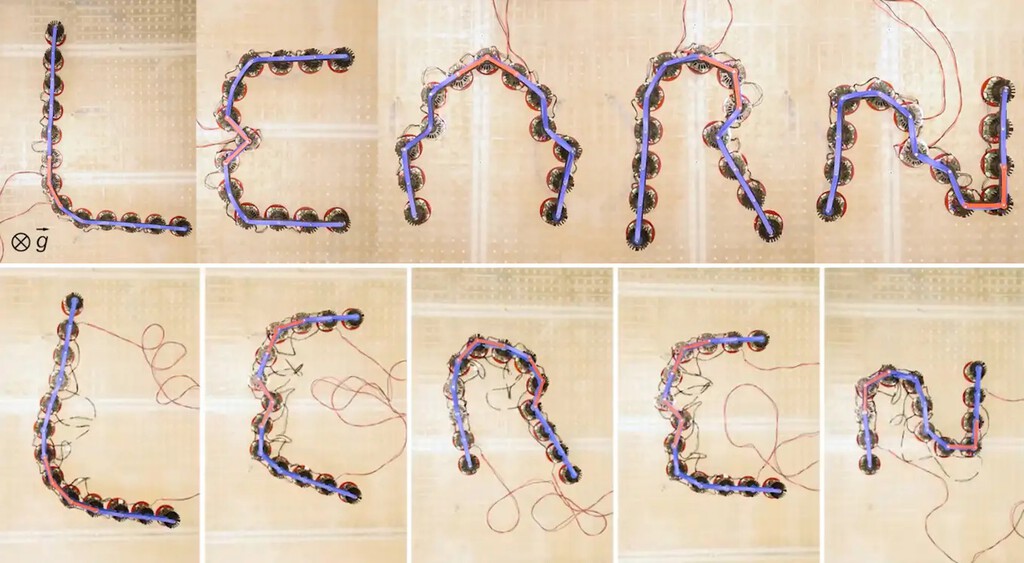
The University of Amsterdam has unveiled a metamaterial that learns to change shape and moves autonomously, blurring the line between objects and living systems. Published in Nature under the title “Metamaterials that learn to change shape,” this research showcases worm-like segments connected by motorized hinges with microcontrollers, enabling each segment to “learn” new configurations without centralized control.
What Are Metamaterials and Why This Breakthrough Matters
Metamaterials are engineered structures that derive their properties from their geometry rather than just their composition. By tweaking the internal structure, scientists can create materials with unusual characteristics—like lightweight shields stronger than thick steel plates, or materials that morph into desired shapes.
Find Original Home Decor sparking conversation at Grand Goldman Shop.

This latest work pushes the boundary further: the Amsterdam team has created a material that exhibits autonomous shape-learning. Each segment acts as a node in a distributed network, sharing information with neighbors to collectively adapt.
How the Shape-Shifting Metamaterial Works
The material consists of multiple segments, each linked by a motorized hinge equipped with a microcontroller. These microcontrollers measure parameters such as rotation and previous movements, storing a kind of memory. They then send signals to adjacent hinges, which adjust their stiffness and position accordingly.
This decentralized approach means no central computer orchestrates the overall shape. Instead, each segment “learns” from local interactions, gradually converging on a target configuration. The researchers train the material by sending impulses that encourage the segments to organize into desired shapes.
Key Components and Their Functions
- Segments: Physical building blocks that can rotate and change stiffness.
- Motorized hinges: Actuators that enable movement between segments.
- Microcontrollers: Local processors that measure rotation, store movement history, and communicate with neighbors.
- Learning algorithm: Distributed logic that allows the material to adapt based on past inputs.
- Training protocol: External impulses that guide the material toward desired shapes.
Why This Research Is a Game-Changer
This metamaterial challenges conventional notions of what an object can be. Unlike traditional materials, which have fixed properties, this system can learn and evolve its behavior over time. The implications span robotics, adaptive structures, and even medical devices.
For instance, imagine a bridge that reinforces itself under stress, or a medical implant that changes shape to fit a growing child. The decentralized learning approach also offers robustness: if one segment fails, others can compensate.
Potential Applications Across Industries
The ability of metamaterials to learn and adapt opens doors in numerous fields. In aerospace, adaptive wings could optimize lift and drag in real time. In construction, buildings could respond dynamically to environmental loads. In consumer products, items could morph to suit user preferences.
However, challenges remain. Powering and controlling thousands of microcontrollers in a single material requires careful engineering. Scalability and cost-effectiveness will determine how quickly this technology reaches the market. The longer history behind the story is traced in Amsterdam's Shape-Shifting Metamaterial That Learns and Moves.
Comparison with Other Adaptive Materials
While shape-memory alloys and piezoelectric materials can change shape in response to stimuli, they lack the ability to learn from past movements. The Amsterdam metamaterial stands out because it incorporates memory and distributed intelligence, enabling more complex, autonomous behaviors. The background to this story is set out in Parasites Unveiled: Championing Nature's Most Misunderstood Villa. A related thread runs through Parasites Unveiled: A Mission to Champion Nature’s Villains. Earlier coverage in Parasites Unveiled: One Man’s Mission to Champion Nature’s Villai shows how the argument developed.
| Material Type | Adaptability | Learning Capability | Decentralized Control |
|---|---|---|---|
| Shape-memory alloys | Limited to predefined shapes | No | No |
| Piezoelectric materials | Reversible deformation | No | No |
| Amsterdam metamaterial | Highly adaptable | Yes | Yes |
What to Watch Next in Metamaterial Development
The team’s publication in Nature signals a significant step toward materials that behave more like biological organisms. Future research will likely focus on scaling down the components, improving energy efficiency, and exploring new training algorithms. A closer look at the same subject appears in Young Nature Writers: Get Published in The Guardian Today. Anyone following the wider picture can start with Science: latest articles. The same theme surfaces in DART Mission Reshaped Dimorphos: Asteroid Changed Form, which takes a different angle.
As metamaterials gain the ability to learn, they could revolutionize how we design everything from furniture to spacecraft. The line between living and non-living matter is indeed becoming blurred. Context on how this played out before sits in China Finds Fluorescent Moon Mineral That Could Transform LED Bulbs. A companion piece, New Mars Route via Asteroid 2001 CA21 Cuts Trip to 153 Days, approaches the same subject from another angle.
FAQ
What is a metamaterial that learns to change shape?
It is an engineered material composed of segments with motorized hinges and microcontrollers that can adapt their configuration based on past movements, effectively “learning” new shapes.
How does the Amsterdam metamaterial move without a central computer?
Each segment communicates with its neighbors, sharing information about rotation and stiffness. This decentralized network allows the material to collectively organize into desired shapes through local interactions.
What are the potential applications of this technology?
Applications include adaptive aerospace components, self-reinforcing structures, medical devices that change shape, and consumer products that morph to user needs.
Is this metamaterial commercially available?
No, it is currently a research prototype. Challenges such as power supply, scalability, and cost must be addressed before commercialization.







